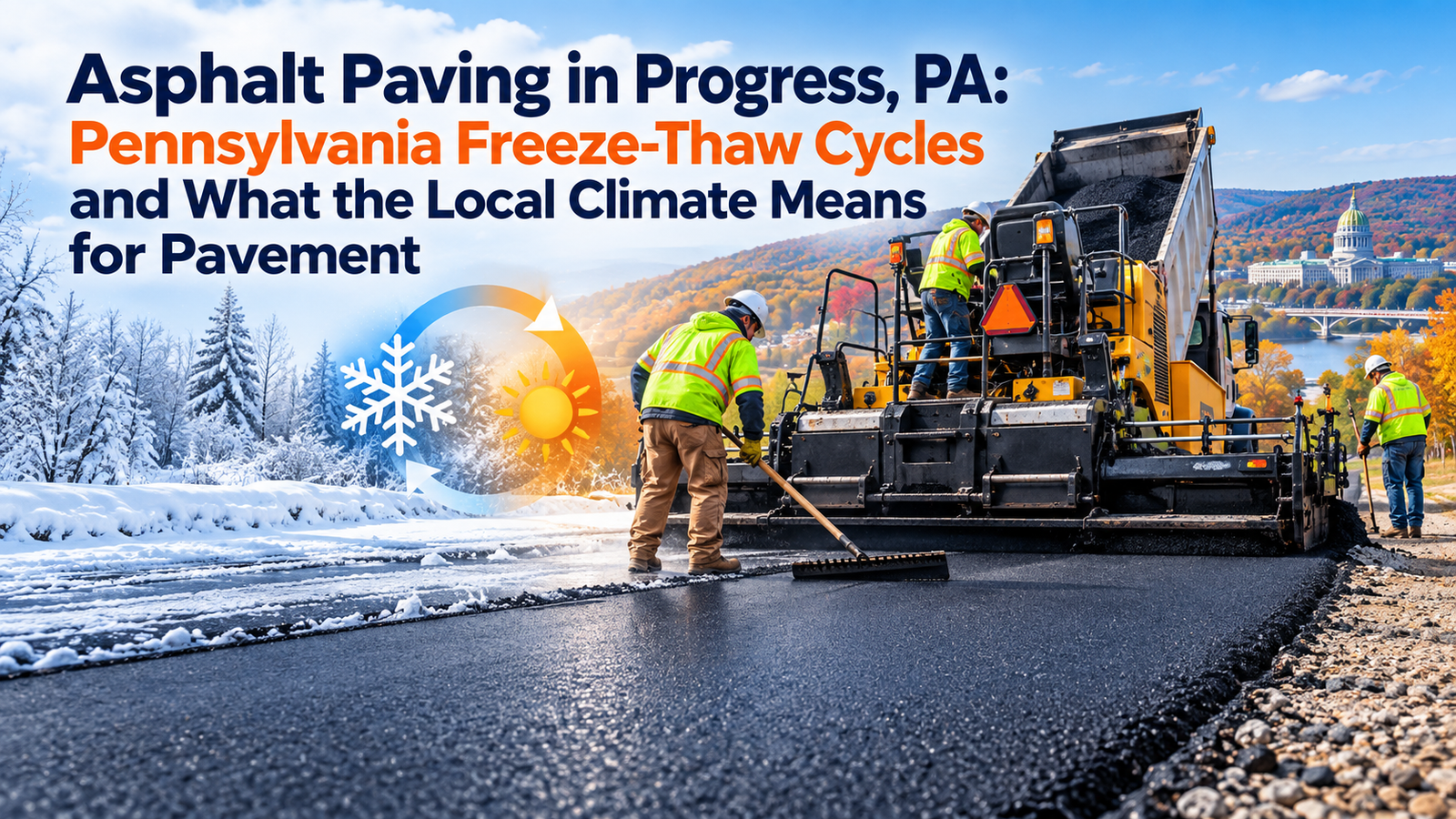
Progress is a census-designated place within Susquehanna Township, Dauphin County, positioned along the northeastern approach to Harrisburg. The community occupies a mix of residential neighborhoods, commercial corridors, and light industrial parcels in the Capital Region’s inner ring. Its streets, driveways, and parking lots are subject to the same climatological forces that affect all of central Pennsylvania but the specific combination of the township’s flat topography near the Susquehanna River, its soil composition, and its position in the Harrisburg metro drainage basin creates pavement conditions that reward careful installation and regular maintenance.
Pennsylvania’s climate sits at a transition point between the more severe winter conditions of northern New England and the relatively mild winters of the mid-Atlantic coast. In the Harrisburg area, winter temperatures regularly cross below and above the 32-degree Fahrenheit freezing threshold on the same day, a pattern that generates freeze-thaw cycles that damage unprotected pavement far more effectively than sustained cold temperatures would. Understanding this mechanism, and understanding what professional Asphalt Contractor Progress installation does to counteract it, is the starting point for any meaningful discussion of pavement in Progress, PA.
How Pennsylvania Freeze-Thaw Cycles Damage Pavement
When water enters a crack in an asphalt surface and freezes, it expands by approximately nine percent in volume. That expansion exerts forces on the surrounding asphalt that can exceed the tensile strength of the pavement, widening the crack with each cycle. The Harrisburg area typically experiences 35 to 50 freeze-thaw cycles annually days when temperatures move through the freezing point. Over five or ten years without maintenance, these repeated expansions transform hairline surface cracks into full-depth alligator cracking that signals pavement failure.
The subgrade beneath the asphalt is equally affected. Pennsylvania’s Coastal Plain and Valley and Ridge soils in the Harrisburg area include significant clay fractions that swell when saturated and shrink when dry. Frost heave the upward movement of soil when ground moisture freezes can lift pavement sections unevenly, creating differential settlement and surface irregularities. Proper pavement design accounts for frost depth by specifying aggregate base thicknesses that place the frost penetration depth above the critical subgrade layers.
Road salt is the other major factor. PennDOT applies calcium chloride, sodium chloride, and liquid anti-icing agents to state-maintained roads throughout the Harrisburg area, and municipal crews apply similar materials to township and borough roads in Susquehanna Township. Road salt dissolved in runoff migrates through pavement surface cracks and accelerates the chemical breakdown of the asphalt binder the bituminous cement that holds aggregate particles together. Sealcoating the asphalt surface blocks this migration pathway, protecting the binder from both moisture and chloride exposure.
Asphalt Pavement Structure: What Goes Below the Surface
A professional asphalt pavement installation in Progress, PA begins below the surface, with the preparation of a stable subgrade and the placement of a properly graded aggregate base. The subgrade is the natural soil that supports the entire pavement structure. Weak or unstable subgrade soft spots caused by organic material, saturated clay, or inadequate compaction will cause surface failure regardless of how well the asphalt itself is installed.
Subgrade preparation begins with stripping the organic topsoil layer, which is too compressible to serve as a pavement foundation. If soft spots are encountered below the stripped surface, they are excavated and filled with suitable material typically dense-graded aggregate or structural fill and compacted to the specified density. Geotechnical fabric is placed in areas where fine-grained soils have a high potential to migrate up into the aggregate base, a process called pumping that degrades base performance over time.
The aggregate base course provides drainage, distributes loads across the subgrade, and gives the pavement system its resistance to frost. Dense-graded crushed stone typically PennDOT 2A or 2B gradation is placed and compacted in lifts to achieve the required base thickness. For light-duty residential driveways, four to six inches of compacted base is standard. For commercial parking lots with heavy vehicle traffic, base thickness of eight to twelve inches is common.
Asphalt Mix Specifications for the Harrisburg Climate
Pennsylvania uses PennDOT’s superpave mix design system for most asphalt paving work. Superpave mixes are designed using a performance-graded binder specification that matches the asphalt cement to the climate of the installation location. In the Harrisburg area, PG 64-22 asphalt cement is the standard binder for surface course mixes. The 64 designation indicates that the binder maintains adequate stiffness at high pavement temperatures up to 64 degrees Celsius. The -22 designation indicates that it remains flexible at low pavement temperatures down to -22 degrees Celsius, preventing cold-temperature cracking during severe winter nights.
Surface course mixes used in residential and commercial paving in the Progress area are typically a 9.5mm or 12.5mm nominal maximum aggregate size superpave mix. These fine-graded surface mixes provide a smooth ride, adequate skid resistance, and a relatively closed surface texture that resists water infiltration when the pavement is new. As the surface ages and surface course aggregate polishes, permeability increases which is one reason why regular sealcoating is beneficial for extending pavement life.
Driveway Paving in Progress: Residential Considerations
Residential driveway paving in Progress involves conditions typical of the inner-ring suburban neighborhoods of the Harrisburg metro. Lots are generally modest in size, mature street trees are present on many blocks, and the driveway lengths are in the range of 20 to 60 feet from the public curb to the garage or parking area.
Street tree root systems are a recurring complication in driveway and sidewalk paving in established neighborhoods like those in Progress. The fine roots of red maples, silver maples, and sweetgum trees among the most common street trees in Dauphin County spread aggressively into the subsurface near pavement surfaces, where they find water and air. Root intrusion beneath a driveway lifts sections, creates cracking, and can destabilize the aggregate base. Effective installation in root-adjacent areas may include root barriers physical or chemical systems that redirect root growth away from the pavement subbase or root pruning combined with replacement of disturbed base material.
Driveway grades in Progress vary. Properties close to the Susquehanna River floodplain are nearly flat, which benefits drainage but can lead to surface ponding if the driveway crown is insufficient. Properties on the slightly elevated terrain away from the river may have modest slopes that must be managed with proper surface drainage design to prevent runoff from concentrating at the garage approach or at the street connection.
Sealcoating and Crack Sealing: The Maintenance Cycle in Central Pennsylvania
The maintenance cycle for asphalt pavement in central Pennsylvania is driven by the same freeze-thaw dynamics that determine the original installation specifications. Sealcoating the application of a coal tar emulsion or asphalt emulsion coating over the existing pavement surface is the most cost-effective pavement maintenance measure available. Properly applied, a sealcoat blocks moisture intrusion, protects the asphalt binder from oxidation and ultraviolet degradation, and restores the appearance of the surface.
In the Harrisburg climate, sealcoating is typically performed between late April and mid-October, when air and pavement temperatures are above 50 degrees Fahrenheit and rain is not expected for at least 24 hours after application. The application must be preceded by crack sealing the filling of existing cracks with hot-pour rubberized sealant to prevent moisture from traveling through the crack system after the sealcoat is applied. A sealcoat applied over unsealed cracks provides no benefit at the crack locations and can give a false appearance of a sealed surface.
The recommended sealcoating frequency in central Pennsylvania is every three to four years, beginning two to three years after the initial installation. New pavement should not be sealed until the asphalt has cured sufficiently for the volatile oils in the mix to evaporate sealing too early traps those oils and can lead to soft surface conditions and loss of adhesion.
Frequently Asked Questions: Asphalt Paving in Progress, PA
How do freeze-thaw cycles damage asphalt in the Harrisburg area?
Water enters existing cracks, freezes and expands by nine percent, widening the crack with each cycle. The Harrisburg area experiences 35 to 50 freeze-thaw cycles per year. Road salt accelerates binder breakdown. Proper installation and regular maintenance are the primary defenses against this damage mechanism.
What base thickness is needed for a residential driveway in Progress?
Four to six inches of compacted dense-graded aggregate base is standard for residential driveways. Commercial lots with heavy vehicles require eight to twelve inches. Base thickness is calibrated to the frost depth and the load demands of the specific application.
When is the right time to sealcoat asphalt in central Pennsylvania?
Between late April and mid-October, when temperatures are consistently above 50 degrees. New pavement should wait two to three years before first sealcoating. Cracks should be filled with hot-pour rubberized sealant before sealcoating to prevent moisture from traveling through the crack system.
What causes pavement failure near tree roots?
Tree root systems expand into the subsurface beneath driveways, lifting and cracking the pavement from below. Root barriers can redirect roots away from the pavement. Disturbed base material must be re-compacted or replaced when roots are removed.
What asphalt mix is used in the Harrisburg area?
Superpave mixes designed to PennDOT specifications, typically using a PG 64-22 performance-graded binder that maintains flexibility at low winter temperatures and stiffness at high summer pavement temperatures.
Asphalt paving in Progress, PA rewards careful attention to the climate-driven forces that dominate pavement performance in central Pennsylvania. Freeze-thaw cycling, road salt exposure, and subgrade conditions in the Harrisburg area are constants that well-designed, properly installed, and regularly maintained pavement systems are built to handle.